COBRA vs ACA Marketplace: How to Budget Health Insurance After Leaving Your Job (2026)
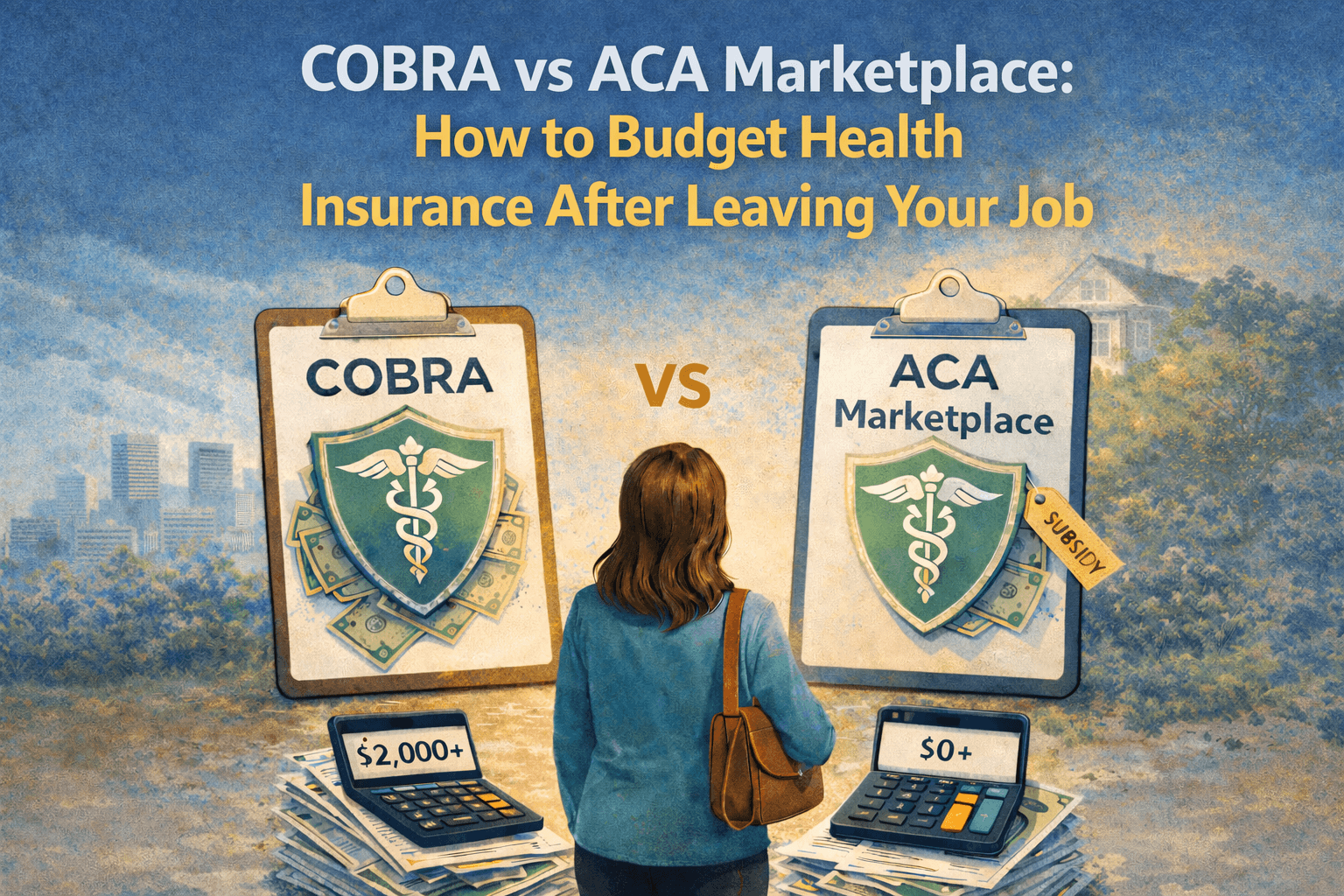
When you leave a job, your health insurance doesn't follow you home. Employer-sponsored coverage typically ends the last day of the month you leave, and what replaces it can cost anywhere from $0 to $2,000+ per month. For anyone building a financial runway, health insurance is the line item that surprises people the most, and underestimating it can quietly eat months off your timeline.
This one line item can change your runway by months. Whether you choose COBRA or an ACA Marketplace plan, the difference in monthly cost can be hundreds of dollars, and the right choice depends on your income, your health needs, and how long you plan to be between jobs.
Don't let health insurance be the surprise that cuts your runway short. Model it now with QuitRunway →
Why Health Insurance Is the "Hidden" Runway Line Item
Most people budget for rent, groceries, and debt payments when planning time away from work. Health insurance often gets a vague estimate or, worse, gets forgotten entirely until the first bill arrives.
Here's why it matters so much for runway planning:
- The cost jump is immediate. While employed, your employer likely covered 70–80% of your premium. When you leave, you're responsible for the full amount.
- It's a fixed monthly expense. Unlike groceries or entertainment, you can't cut your health insurance premium by 20% on a tight month.
- Unexpected medical costs compound the problem. Without coverage, a single ER visit can cost $2,000–$5,000+, which could wipe out months of careful budgeting.
The good news: you have two main options, COBRA and the ACA Marketplace, and understanding both puts you in control.
COBRA in Plain English
COBRA (Consolidated Omnibus Budget Reconciliation Act) lets you keep your exact employer-sponsored health plan after you leave your job. Same doctors, same network, same coverage. The catch? You pay the full premium yourself.
How COBRA works
- Eligibility: Available if your employer had 20+ employees and you had group health coverage. Applies to voluntary quits, layoffs, and reductions in hours.
- Duration: Up to 18 months of continued coverage (36 months in some qualifying events like divorce or a dependent aging out).
- Election window: You have 60 days from your coverage loss date to elect COBRA. Coverage is retroactive to the day your employer plan ended, so there's no gap even if you wait.
- Cost: You pay 100% of the premium plus up to a 2% administrative fee. This means you're covering what your employer used to pay on your behalf.
Why COBRA feels expensive
If your employer was paying $1,200/month toward your family plan and you were paying $400/month via paycheck deductions, your COBRA cost is roughly $1,600/month (the full premium), not the $400 you're used to seeing. This sticker shock catches many people off guard.
For individuals, COBRA typically runs $600–$900/month. For families, expect $1,500–$2,200/month. Your specific cost depends on your employer's plan.
ACA Marketplace in Plain English
The ACA Marketplace (also called the Health Insurance Exchange, or Healthcare.gov in most states) is where you shop for individual health insurance plans outside of an employer. Plans are standardized into metal tiers: Bronze, Silver, Gold, and Platinum.
How the ACA Marketplace works
- Eligibility: Anyone who isn't incarcerated and doesn't have access to employer-sponsored coverage can enroll. Losing job-based coverage triggers a Special Enrollment Period (SEP).
- Enrollment: You have 60 days from your qualifying event (losing employer coverage) to enroll. Go to Healthcare.gov or your state's exchange.
- Subsidies: Premium tax credits are based on your expected household income for the year relative to the Federal Poverty Level (FPL). Lower expected income generally means larger subsidies and lower monthly premiums.
- Cost range: Unsubsidized plans run $300–$800+/month for individuals. With subsidies, many people pay $0–$200/month for a Silver plan.
The key variable is your expected income for the coverage year. If you're leaving a job mid-year, your annual income will likely be lower than a full year of salary, which can significantly increase your subsidy.
COBRA vs ACA Marketplace: A Decision Framework
There's no universal "right" answer. The best choice depends on your specific situation. Here's a practical framework:
Choose COBRA when:
- You're in the middle of ongoing medical treatment and need to keep your current doctors and network
- You've already met a significant portion of your annual deductible and don't want to reset it
- You need coverage immediately with zero paperwork delay
- You expect to be back on employer coverage within 2–3 months (short gap)
- Your expected income for the year is too high to qualify for meaningful ACA subsidies
Choose ACA Marketplace when:
- Your expected annual income (not your previous salary) qualifies you for subsidies
- You plan to be without employer coverage for 4+ months, as the monthly savings add up fast
- You don't need a specific provider network and can switch to a new plan
- You want more plan options (different deductible/premium tradeoffs)
- You're leaving a high-premium employer plan and the ACA alternative is significantly cheaper
Common scenarios
- Need coverage immediately: Elect COBRA now, then switch to ACA during your 60-day SEP window. COBRA is retroactive, so you're covered from day one while you shop.
- Income will change significantly: If you're going from a $120K salary to $0 income for the rest of the year, your ACA subsidies could be substantial. Run the numbers.
- Specific doctors or medications: Check if your providers are in-network on available ACA plans before switching. If they are, ACA may save you money with the same access.
Budgeting Health Insurance After a Job: Step by Step
This is the core exercise. Set aside 10 minutes and walk through these steps:
-
Estimate your gross-to-net income for the next few months.
Add up any remaining paychecks, severance, unemployment benefits, side income, and investment income. This is your expected annual income for the year, which drives ACA subsidy calculations.
-
Get your COBRA premium quote.
Your employer's HR department or benefits administrator will send you a COBRA election notice with the exact monthly cost. If you haven't received it yet, ask HR directly.
-
Estimate your ACA Marketplace premium.
Go to Healthcare.gov and use the "See Plans & Prices" tool. Enter your expected income for the year (not your previous salary). Compare Silver plans for the best balance of premium and coverage.
-
Add out-of-pocket costs as a range, not a single number.
Monthly premiums are only part of the picture. Estimate a realistic range for deductibles, copays, and prescriptions. For a healthy individual, budget $50–$200/month on top of premiums. If you have ongoing care, budget $200–$500/month.
-
Compare total monthly cost: COBRA vs ACA.
Premium + estimated out-of-pocket for each option. The cheapest premium isn't always the cheapest total cost if the deductible is much higher.
-
Plug the number into your runway model.
Add your chosen health insurance cost to your monthly expenses. See how it affects your total runway in months.
10-minute checklist
- Write down your expected annual income for the rest of the year
- Check your COBRA election notice for the monthly premium
- Run a quick quote on Healthcare.gov with your expected income
- Note the monthly premium for a Silver ACA plan in your area
- Add $100–$300/month as a buffer for out-of-pocket costs
- Compare COBRA total vs ACA total
- Enter the higher number into your runway calculator as a conservative estimate
The Subsidy Reality Check (ACA) in 2026
ACA subsidies (premium tax credits) are based on your expected household income for the calendar year, measured as a percentage of the Federal Poverty Level. In 2026, here's what matters for your planning:
- Expected income, not previous salary. If you earned $100K through June and expect $0 for the rest of the year, your annual income estimate might be around $50K, not $100K. That lower number determines your subsidy.
- Be realistic, not optimistic. If you think you'll earn $20K in freelance income but aren't sure, estimate conservatively. You can update your income estimate on the Marketplace if things change, and you'll reconcile at tax time.
- For runway planning, use the worst-case premium. Estimate your subsidy based on a realistic income number, but budget for the scenario where your income is slightly higher (and the subsidy slightly lower). This keeps your runway projection conservative.
- Income near the subsidy cliff matters. Small changes in expected income can result in meaningful changes in your monthly premium. If you're near a threshold, model both sides.
The bottom line: subsidies can make ACA plans dramatically cheaper than COBRA, but only if your expected income qualifies. Don't assume. Run the numbers, and budget conservatively.
Common Mistakes to Avoid
-
Assuming COBRA is cheaper than it is.
Most people only saw their employee portion of the premium. The full COBRA cost is typically 3–4x what you were paying per paycheck. Always get the actual number before deciding.
-
Waiting too long to enroll.
Both COBRA and ACA have 60-day enrollment windows. Miss them and you could face months without coverage and no way to get it until the next Open Enrollment period.
-
Underestimating out-of-pocket costs.
A $200/month premium with a $8,000 deductible means you're paying $200/month plus the first $8,000 of care out of pocket. Budget for both the premium and realistic out-of-pocket spending.
-
Not planning for premium changes as income changes.
If you start freelancing and your income goes up, your ACA subsidy may go down, increasing your monthly premium. Build this into your projections.
-
Forgetting the coverage gap risk.
If your employer coverage ends March 31 and your ACA plan doesn't start until May 1, you have a gap. COBRA can cover this retroactively, but only if you elect it within 60 days. Don't let administrative delays leave you uninsured.
-
Using your old salary as income on the ACA application.
The Marketplace asks for expected annual income, not your previous salary. If you're unemployed for part of the year, your annual income is lower, and your subsidy will be higher.
Health Coverage Timeline: Quick View
Here's what a typical transition looks like. Exact dates vary, but the sequence matters:
- Last day of employment: Employer coverage typically continues through the end of the month. Check with HR for your specific end date.
- Coverage ends: The day after your employer plan terminates. This is your "qualifying life event" date for both COBRA and ACA.
- COBRA election window (60 days): You receive a COBRA election notice from your former employer. You have 60 days to decide. Coverage is retroactive to your loss date, so there's no gap even if you wait to decide.
- ACA Special Enrollment Period (60 days): Losing employer coverage triggers a 60-day SEP. You can enroll in a Marketplace plan during this window regardless of the annual Open Enrollment schedule.
- ACA coverage start date: Typically the first of the month after you enroll. If you enroll March 20, coverage may start April 1.
- Ongoing: Review your coverage and costs quarterly, especially if your income changes. You can update your ACA application if your income estimate changes significantly.
Note: This is general guidance, not legal or benefits advice. Exact timelines depend on your employer, your state, and your specific plan. Always confirm details with your benefits administrator or Healthcare.gov.
Runway Modeling: How Health Insurance Affects Your Timeline
Health insurance isn't just a line item. It's a runway multiplier. Here's how the math works in practice:
Example: COBRA vs ACA impact on runway
- Savings: $40,000
- Monthly expenses (before health insurance): $3,000
- COBRA cost: $1,400/month → Total expenses: $4,400 → Runway: 9.1 months
- ACA (with subsidy) cost: $250/month → Total expenses: $3,250 → Runway: 12.3 months
Choosing ACA over COBRA adds 3.2 months of runway in this scenario.
That's the difference between a comfortable job search and a panicked one. And it's why modeling health insurance costs, rather than guessing, matters so much.
With QuitRunway, you can model multiple scenarios side by side:
- Best case: ACA with full subsidy, low out-of-pocket costs
- Expected case: ACA with moderate subsidy, average out-of-pocket buffer
- Worst case: COBRA at full price, higher out-of-pocket spending
Comparing all three gives you a realistic range for your runway, not just one number that might be too optimistic.
Ready to Calculate Your Runway?
Use our free calculator to see exactly how long your savings will last.
Try QuitRunway Free →